

We often treat speaking as if it’s the only way we can think together.
That’s why brainstorming tends to imply a heated discussion where everyone speaks over one another.
That’s why collective decision-making often involves a verbal exchange not so different from arguing.
But is it really effective? Not necessarily.
Silent meetings flip the default. They intentionally include quiet time during the meeting so everyone can read, think, and write before the group discusses.
Sounds counterintuitive? Read on.
What a silent meeting is (and what it isn’t)
A silent meeting is a structured working session where participants spend a significant portion of the time in silence – reading, reflecting and writing – and shift to discussion only for points that genuinely need live conversation.
It’s not a “no talking ever” rule.
It’s a deliberate choice of “prepare first, talk second”.
The goal is to give everyone the same starting line. Instead of assuming people have read the doc or done the “homework” beforehand (and crossing your fingers that they actually did), the meeting builds in that prep time in. Everyone reviews the same material, at the same moment, and comes into the discussion equally informed, prepared and with their thoughts on paper.
It’s a very equalizing meeting format. It reduces the usual imbalance where a few people show up prepared (or simply speak up fastest), while others stay quiet or scramble to keep up. Silent time creates space for more thoughtful input and gives everyone an equal chance to contribute, not just the most assertive, extroverted or loud voices.

Why “talking it out” fails more often than we care to admit
In our own research we did a few years ago, 42% of attendees said they often leave a meeting without saying what was on their mind. Imagine the impact! Almost half of the ideas, input or insight, are left unsaid. The reasons for that vary.
It’s not because people don’t have anything to contribute. It’s because classic meeting dynamics gets in the way:
- Speed wins. The first people to speak set the direction, often before others have had time to think.
- Confidence looks like clarity. More assertive voices can dominate, even when quieter participants may have equally, or more valuable input.
- Some people are quiet thinkers who need more processing time. For example, non-native speakers may need some extra time to find the right words, or anyone working through complex topics may not be ready to jump in instantly.
- Hybrid meetings tilt the playing field. It’s easier to jump into the flow if you’re in a room than if you’re joining online, so remote participants often contribute less.
- Many people hate to interrupt, especially in larger groups or when the discussion is moving fast.
- We anchor on the first idea. Even confident participants can get influenced by whatever was said first, narrowing the range of options too early.
There’s also a well-known effect behind a lot of this: production blocking. When one person is talking, everyone else is forced into “listener mode” which makes it harder to generate ideas, remember them, and find the right moment to share.’
This is the magic of silent meetings.
The moment you remove the race to speak, you get more thoughtful input, especially from the people who are usually drowned out.
Silent time creates parallel thinking: everyone can contribute at once, in writing, before the group converges on discussion. The result is more ideas on the table, less anchoring and a conversation that starts from substance.

Where silent meetings work best
Rule of thumb: Use silent meetings when you want deep thinking, careful analysis, better-written ideas, thoughtful feedback, considered decisions.
Ideal formats for silent meetings are:
- board and leadership meetings,
- management meetings,
- brainstorming,
- retrospectives,
- strategy and planning meetings,
- feedback and evaluation sessions.
High-stakes decisions (board / leadership / management meetings)
Considering an acquisition, rebrand or major campaign? Silent meetings are often built around a shared “table read” document that everyone reads and comments on during the meeting – ideal for important, high-stakes proposals.
For example, spend the first half of the meeting time reading the material to make sure each stakeholder is 100% informed on all the details. Prompt people to write down comments in silence. Then open discussion.
Brainstorming
If you’ve ever left a brainstorm thinking “we only heard from the usual people,” silent brainstorming, or brainwriting, is your fix. Generating ideas in silence can produce more ideas (and better ideas) than traditional out-loud brainstorming.
Planning, prioritization and strategy sessions
These meetings tend to spiral: too many topics, too many opinions, not enough structure. Silent input lets you collect priorities before debate starts, vote on what matters e.g. via a Slido poll and discuss only the top items.
Retrospectives and feedback sessions
A bit of facilitated silence can be the difference between “everything’s fine” and “here’s what’s actually slowing us down.” Looking back and producing meaningful feedback on what worked and what didn’t takes time and a silent meeting format can help enormously here.
Also, it might be a good idea to allow anonymity, so you’ll get more honest input and get to the real issues much faster.
Reviews and evaluations
This is a perfect silent-meeting moment: when you want independent judgment before group influence kicks in. It’s ideal for reviewing creative concepts, brand experiments or design proposals, so you can collect unbiased input from individual team members.
How to run silent meetings: Facilitation tips
Below are several facilitation tips, helping you to pull off this meeting technique successfully.
 1/ Start with one clear meeting goal
Before you invite anyone, write down what the outcome of the meeting should be. For example:
- “By the end of this meeting, we will decide between A / B / C.”
- “We will leave with the top 5 ideas worth exploring.”
- “We will agree on the top 3 priorities.”
2/ Invite participants and share the context
Include the context for the meeting in the invitation, so that the participants know what to expect. State clearly what the meeting goal is and why you’re meeting.
You can manage expectations from the start, clarifying that there’s no need to come prepared for the meeting, that you will actually be going through the materials together during the meeting.
3/ Set the timer: 10-30 minutes of silent reading / thinking + written input
Lead with a specific question, for example:
- “What are the top risks or unknowns?”
- “What’s missing from this plan?”
- “List 3 ideas we should try next month.”
- “What should we stop / start / continue?”
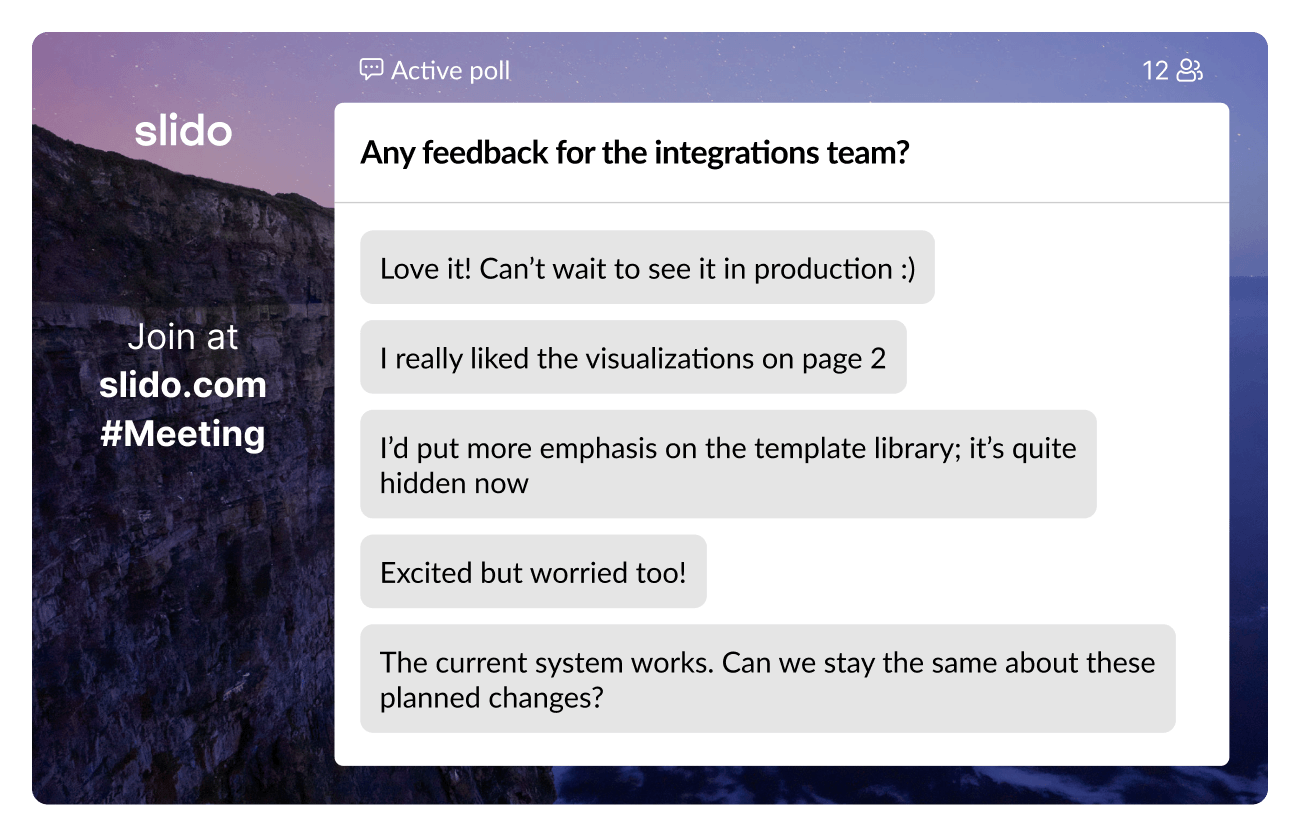
Then ask people to review the material and jot down their input in writing or type their answers in a Slido open text poll. This keeps everyone’s input in one place and creates a record you can refer back to. You can also allow anonymous responses if that helps people speak up.
Note: Keep the timer visible so everyone knows how much time they’ve got left. Also, make sure to make your prompt specific enough. Broad questions like “Any thoughts?” may not do the trick.
4/ Cluster, scan and vote (before discussion)
Don’t jump straight into debating the first comment you see. Instead, as the facilitator, group similar submissions, remove duplicates or run a quick poll to vote if needed. You can do this with a Slido ranking poll or multiple choice poll after collecting ideas, to prioritize the themes that deserve further discussion.
5/ Discuss the top items
When there’s time for discussion, make sure it stays moderated. This is why silent meetings work: discussion becomes synthesis, not improvisation.
- Discuss the top 3–5 themes
- Time-stop each one
- Capture decisions and next steps as you go
6/ Close with decisions, owners, deadlines
End every silent meeting by making the output undeniable:
- What did we decide?
- Who owns what?
- What happens next?
- When do we revisit?
Silent meetings + Slido: a practical pairing
Silent meetings succeed when everyone can contribute safely and have an equal voice in the discussion.
That’s exactly where tools like Slido help:
- Open text polls for brainwriting-style idea capture
- Anonymous mode to unlock honest feedback
- Voting via polls to prioritize before discussion
- Q&A for structured questions (especially in decision meetings)

The payoff is more participation, more inclusivity and higher-quality thinking. You end up with a clearer picture of what the whole group believes, not just what was said out loud.
If you want to try it, keep it small: pick one meeting, replace the first 10–20 minutes of discussion with silent reading + written input and then talk only about the patterns that emerge.
Done well, the benefits of silent meetings are in more structured and more productive discussions that eventually lead to real results.