
Designing a quality brainstorming session is no small feat. More especially with distributed teams or if you have a very specific business goal in mind.
As it often happens, a few people dominate the conversation, remote attendees struggle to jump in, ideas come in too quickly to keep track of. And often, by the end of the meeting, you may have a long list of suggestions, but no clear decision on what happens next.
If the brainstorming session is built only around whoever speaks up in the room, you risk missing valuable ideas.
A good brainstorm should do more than generate ideas. It should help everyone contribute, make quality discussion from the input and turn the strongest ideas into concrete next steps.
Here are five ways to design a more inclusive and productive brainstorming session for hybrid teams.
- Give everyone an equal chance to contribute
- Let people share ideas in advance
- Separate brainstorming time and discussion time
- Turn ideas into clear decisions
- Allow people to post their ideas anonymously
#1: Give everyone an equal chance to contribute
In every team, there are people who are comfortable thinking out loud and people who need more time to formulate their thoughts. Some will jump into the discussion immediately. Others may have great ideas but hesitate to interrupt, especially if they’re joining remotely.
That’s why the first rule of better brainstorming is simple: level the playing field. Let everyone submit their thoughts in parallel.
This helps you avoid the usual pattern where the first few ideas set the tone for the whole discussion, or where louder voices shape the direction of the session.
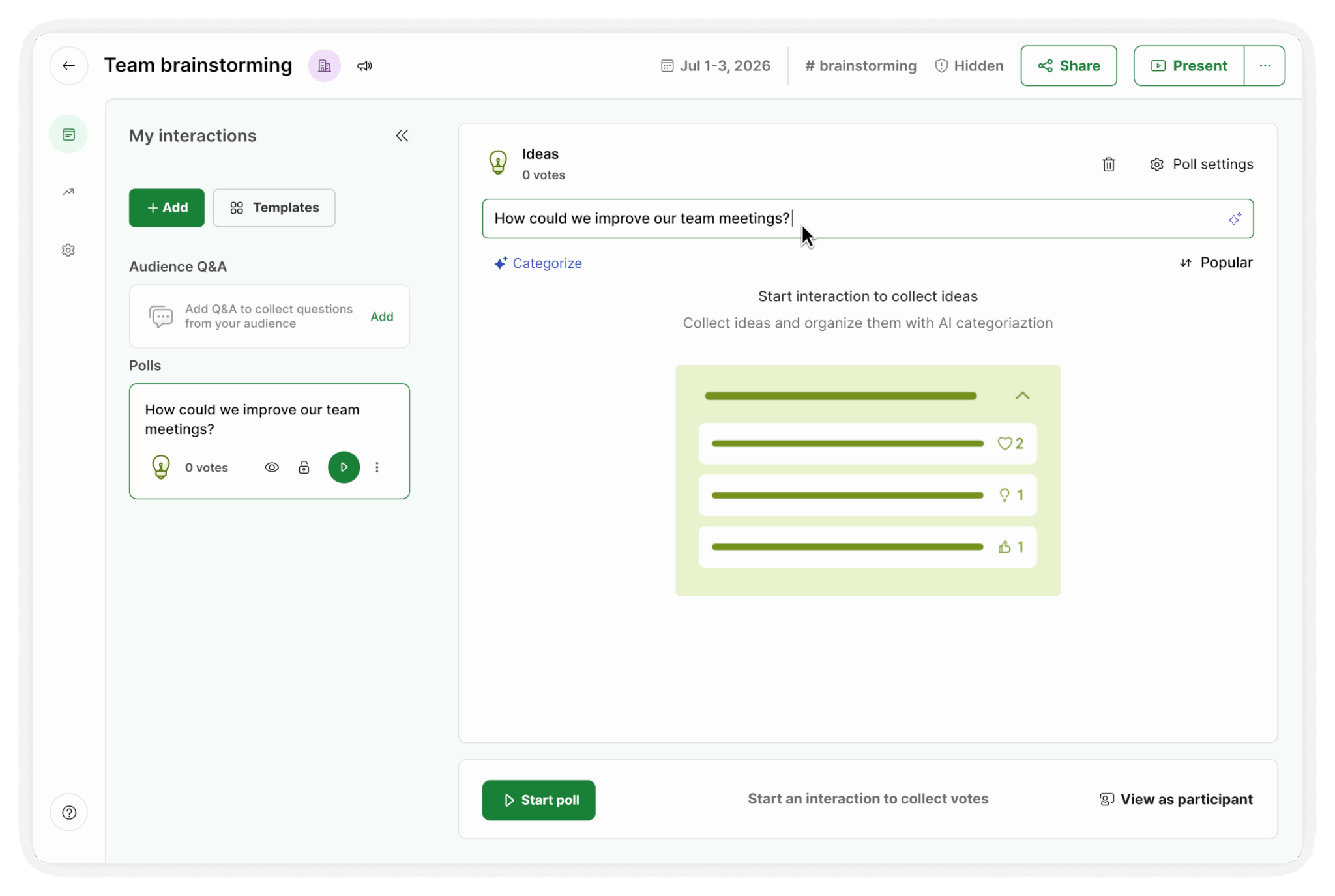
With Slido Ideas, participants can submit their suggestions from their own device, whether they’re in the room or joining online. Everyone contributes in the same shared space, so remote attendees don’t have to fight for airtime and in-room participants don’t automatically have an advantage.
This is especially useful for larger brainstorming sessions. Slido Ideas makes it easy to collect input from small teams as well as bigger groups with many participants, without turning the meeting into a messy wall of sticky notes.
Try this flow:
- Activate your brainstorming topic.
- Give everyone 3–5 minutes to collect their thoughts and submit them to Slido.
- Encourage the use of emoji reactions to see which ideas resonate with the group.
- Discuss.
This way, you create a more balanced start to the conversation and make sure the discussion is built on more than just the loudest voices in the room.
#2: Let people share ideas in advance
Not all ideas have to be thought of during the meeting itself. Some people do their best thinking individually. Others need time to reflect, research or sleep on a problem before they can contribute something useful. And, of course, not everyone may be able to attend the session in person – why not give them a chance to contribute too?
So instead of treating brainstorming as something that starts only once the meeting begins, open it up in advance.
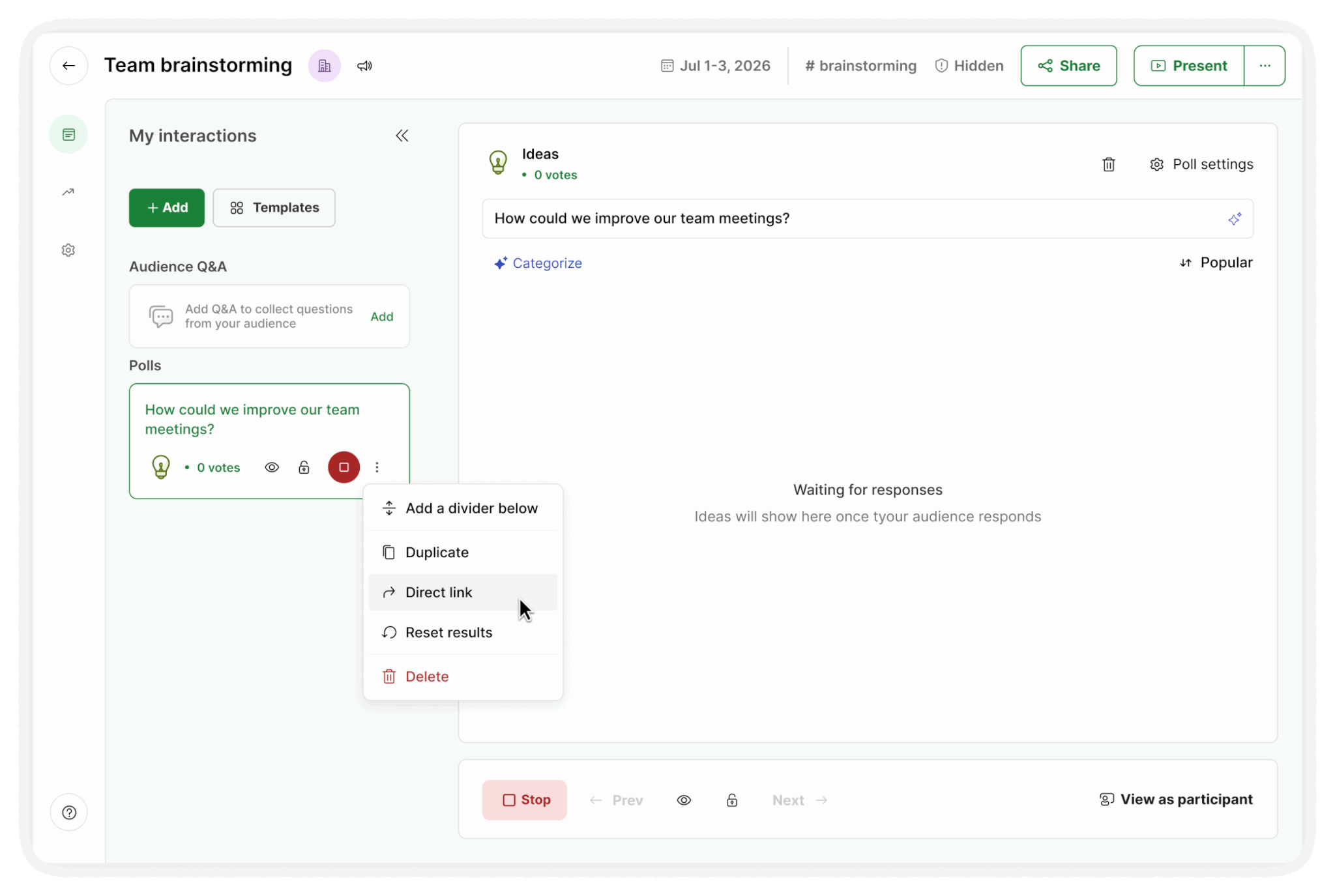
Share your brainstorming question before the session and invite people to submit their ideas asynchronously. This gives your team more time to think and helps you collect input from people who are in different time zones, busy with customer calls or unable to join the meeting live.
With Slido Ideas, you can collect ideas before the meeting and then use the live session for what matters most: discussing, clarifying and deciding what to do next.
This also makes the meeting more inclusive. People who cannot attend can still have their ideas represented and those who prefer to think quietly get a better chance to contribute.
Read also: How to Host More Inclusive Meetings: 15 Essential Tactics
#3: Separate brainstorming time and discussion time
One of the biggest reasons brainstorming sessions become chaotic is that idea generation and discussion happen at the same time.
Someone shares an idea, another person immediately reacts to it, and suddenly the team is debating one suggestion before others have had a chance to contribute. The discussion takes over too early and the range of ideas becomes narrower.
A better approach is to separate the two modes:
First, collect ideas.
Then, organize and discuss them.
This gives people quiet time to think individually and prevents the conversation from influencing the ideas too soon. It also helps the facilitator to stay focused. Instead of trying to read, sort and lead the conversation all at once, you can move through the session in a clear sequence.
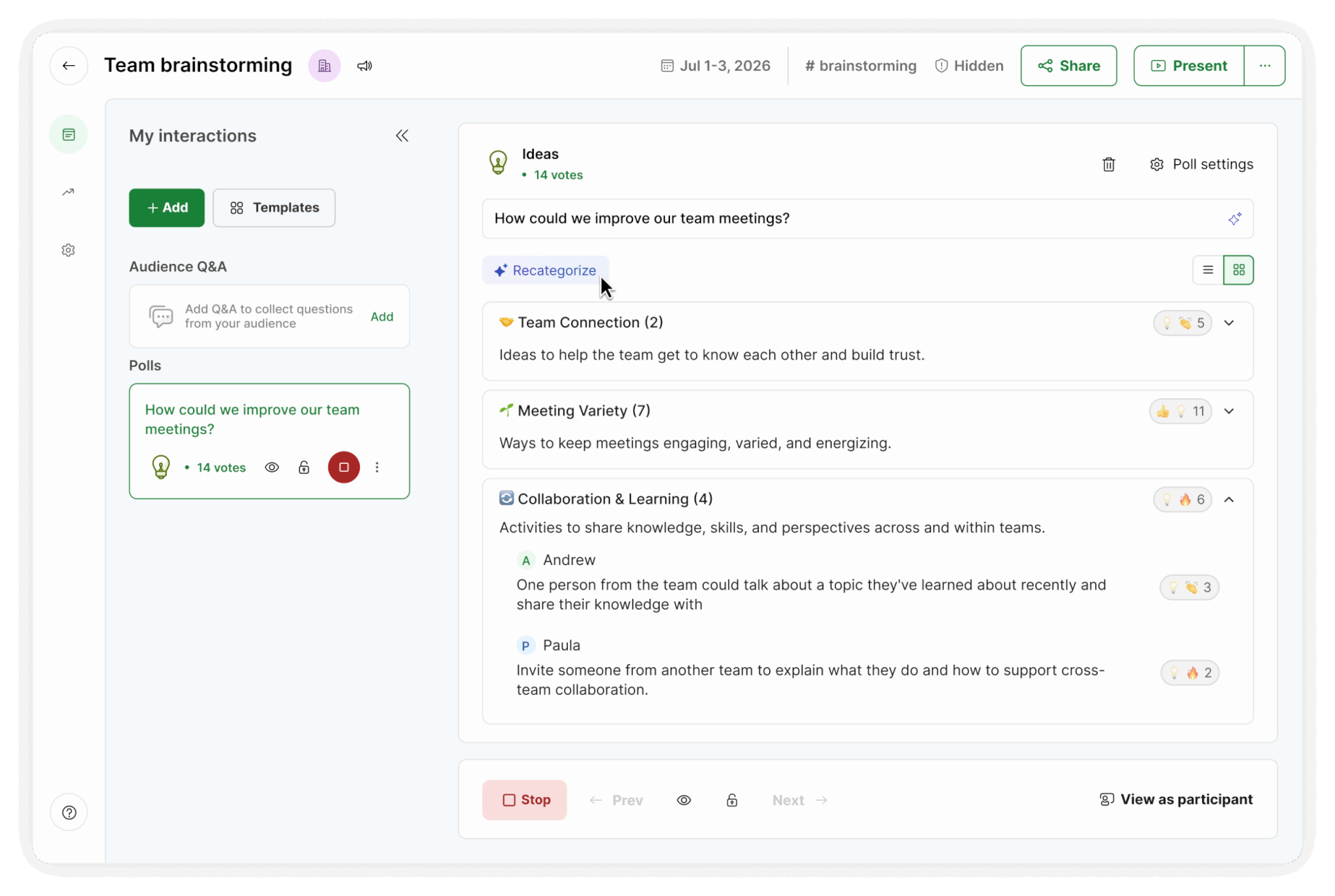
Slido Ideas is especially helpful here because once the ideas are submitted, AI-powered categorization will turn scattered comments into common themes. Similar ideas are grouped together, duplicates become easier to spot and the team can discuss topics instead of going through every single submission one by one.
Try this flow:
- Start with a silent idea entry.
- Once the input is collected, use AI grouping to organize ideas into themes.
- Review the themes with the group.
- Discuss the most relevant categories in more detail.
This makes the discussion more focused. Instead of spending time sorting ideas manually, you can spend it concentrating on what matters most and leave with a plan.

#4: Turn ideas into clear decisions
A brainstorm that ends with no next steps is a missed opportunity. The point of brainstorming is not just to come up with as many ideas as possible, it’s to help the team move forward. That could mean choosing priorities, agreeing on next actions, identifying risks or deciding which ideas are worth exploring further.
This is where many brainstorming sessions fall short. The team generated a lot of input, but the meeting didn’t produce any concrete plan. To avoid this, build prioritization into the flow.
Slido Ideas makes this process easy: Once the ideas are collected and grouped into themes, let participants react with likes or emojis to show which ideas they support. This helps you quickly see what resonates with the team and which topics deserve more attention.
For strategic planning, you can use this flow:
- Ask: “What should be our #1 focus next quarter?” or “What should we stop doing to free capacity?”
- Collect ideas for 3–5 minutes, so everyone can contribute before the discussion starts.
- Categorize ideas to reveal similar suggestions and make the input easier to navigate.
- Discuss the topics in more detail and decide which ones are in scope.
- Let participants or stakeholders vote with emojis to prioritize the most important issues.
- Turn the top priorities into clear next steps, including an owner and first action.
For retrospectives, you can do something similar:
- Collect input around what worked, what didn’t or what should be done differently.
- Group responses into themes.
- Vote on the most important categoriestopics to discuss.
- Agree on one or two concrete improvements to try next.
This helps the team move from possibilities to decisions while everyone is still present. It also makes the outcome clearer: not just a list of ideas, but a set of priorities and next steps.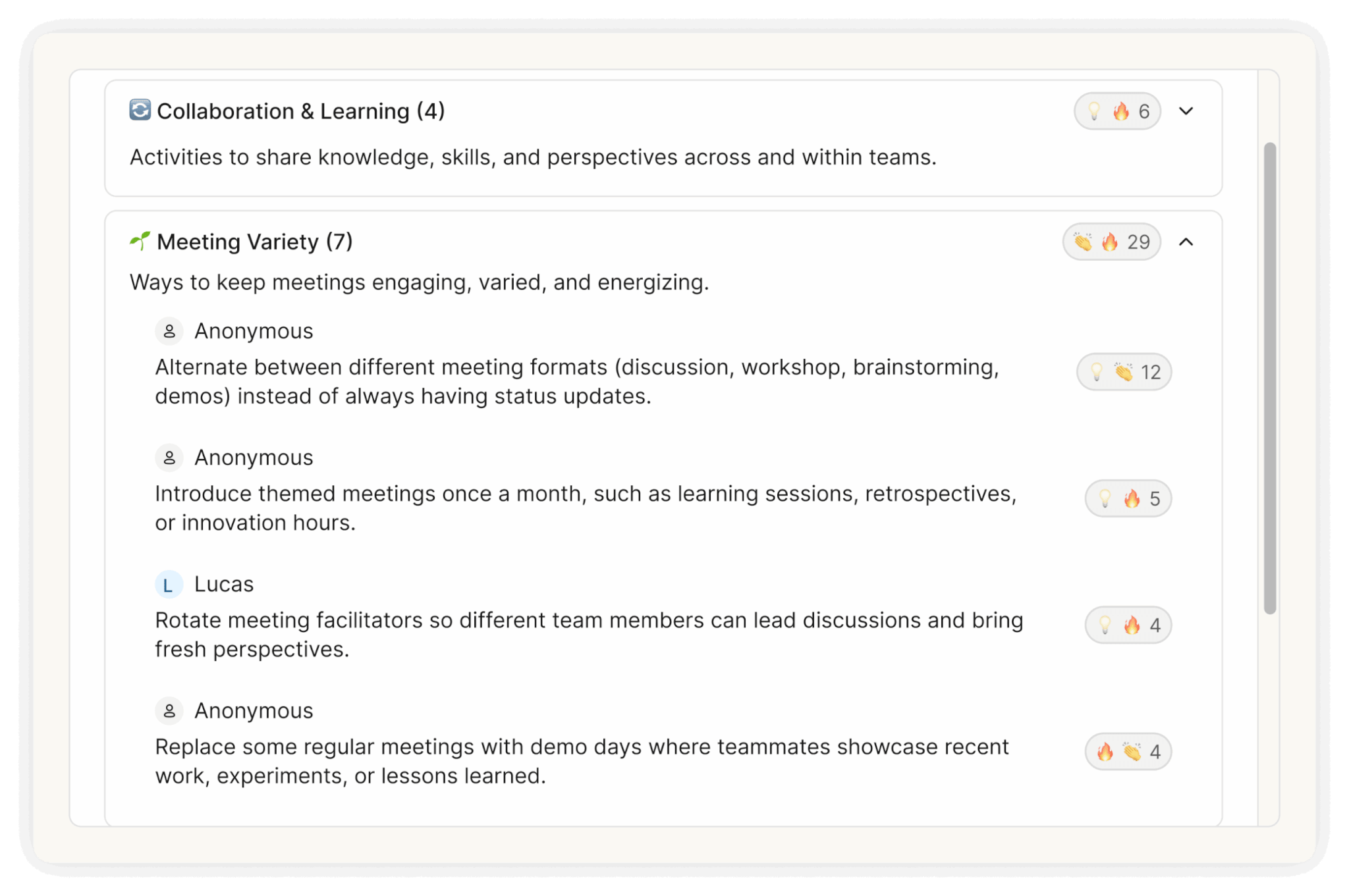
#5: Allow people to post their ideas anonymously
Even in healthy teams, some ideas are easier to share anonymously. People may hesitate to challenge a plan, raise a risk, point out a problem or suggest something unconventional if their name is attached.
Anonymous idea submission can help people be more honest and more creative. It lowers the pressure and gives everyone a safer way to contribute.
With Slido, participants can share ideas with their name or anonymously, depending on the type of conversation you want to create.
Use anonymity especially when:
- the topic is sensitive,
- you want honest feedback,
- there is a strong hierarchy in the room,
- some participants may feel less confident speaking up,
- you want to encourage more unconventional ideas.
Anonymity does not mean the discussion becomes less constructive. In fact, it can help surface the ideas, concerns and questions that would otherwise stay hidden. Once the input is collected, the team can still discuss the themes openly and decide what to do next.
The goal is not to remove accountability. The goal is to make it easier for good ideas to enter the conversation in the first place.

Over to you
Every idea matters, but not every brainstorming session makes space for every idea. A productive brainstorm needs to include everyone: remote attendees, quieter team members or people who cannot join the meeting live.
With Slido Ideas, you can collect ideas from everyone live or async, let Slido AI features group them into clear themes and let the team prioritize what matters most. Instead of leaving your brainstorm with a list of suggestions, you can leave with a plan for what happens next.
Ready to run a more inclusive and productive brainstorming session?